Your AI Automation Will Outlive the Model It's Built On
GPT-4's accuracy on a simple task fell from 84% to 51% in three months, same vendor, same model name, nobody touched the workflow. The fix is building the workflow so the model underneath it can change without breaking anything.

In June 2023, GPT-4’s accuracy on a simple prime-number identification task dropped from 84.0% to 51.1%. Same vendor, same model name, three months apart. Researchers at Stanford and UC Berkeley tracked the shift and found instruction-following and formatting behavior moved too, not just raw accuracy. Nobody changed the workflow. The model changed underneath it.
That is the risk most AI automation ignores. Teams build a pipeline around what one model does today: its tone, its formatting habits, the exact way it structures a JSON blob. Then the vendor ships an update, a deprecation, or a quiet default change, and the pipeline breaks in production. The fix isn’t picking a “better” model. It’s building so the model can change without the workflow noticing.
What model-agnostic actually means
Model-agnostic doesn’t mean model-indifferent. Every model still differs on cost, latency, context window, and tool support, and a real system accounts for that. What changes is where the intelligence lives. Split the stack into three layers:
- Workflow layer: orchestration, retries, state, approvals, business rules
- Contract layer: schemas, tool signatures, validation, acceptance criteria
- Model layer: the language or multimodal reasoning itself
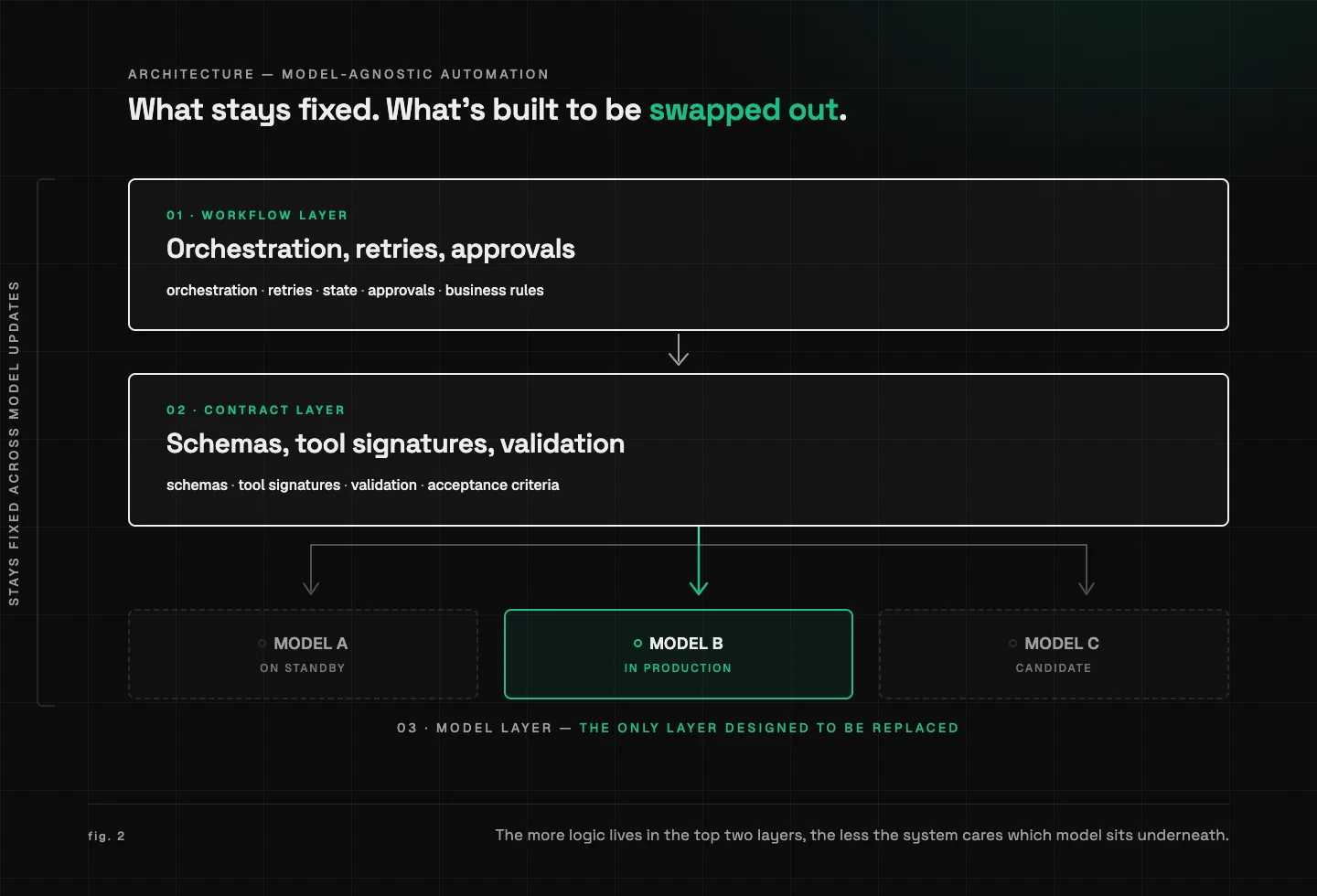
The more logic you push up into the workflow and contract layers, the less the system cares which model sits underneath. OpenAI’s guidance for agent systems is explicit on this: choose models deliberately per task, don’t inherit a silent runtime default. Google Cloud’s model registry treats model versions as lifecycle objects you reference by alias, not hard-coded strings buried in application code.
Five ways coupled workflows break
Prompt-coupled parsing. If your code assumes the model always returns the same headings or delimiter style, a quality-improving update can still break the parser. This is exactly why OpenAI built Structured Outputs: unconstrained text is too brittle for machine-consumed pipelines. Their function-calling docs confirm that strict: true guarantees generated arguments match your JSON Schema. Without that, you’re parsing hope.
Behavior drift under the same service name. The Chen, Zaharia, and Zou study above is the clearest evidence: the “same” hosted model can shift substantially in weeks. Anthropic’s own postmortem of three infrastructure issues makes the same point from the inside: between August and September 2025, a runtime optimization on TPU serving infrastructure quietly distorted token-selection probabilities, producing garbled or foreign-language output. No one touched a prompt. No one swapped a model. The serving stack changed underneath a model that, on paper, hadn’t. If your workflow depends on how a model usually phrases an answer, you don’t have an interface. You have an assumption that hasn’t broken yet.
Default drift and forced upgrades. OpenAI’s deprecation policy gives generally-available models at least six months of notice before retirement. Microsoft’s floor for Azure OpenAI GA models is at least 60 days, inside an 18-month lifecycle from launch to retirement. Both numbers matter less than what they imply: retirement is scheduled, not optional, and “we’ll deal with it later” has an expiration date attached whether you tracked it or not. Azure deployments can be set to auto-upgrade when a new default ships, auto-upgrade only at expiration, or never auto-upgrade. “Never” isn’t a safe steady state. It just means the deployment stops working the day the old model retires. Preview deployments get as little as 30 days’ notice before a force-upgrade, sometimes to a version that wasn’t previously available in that region at all.
Cost and latency coupling through session structure. Anthropic treats prompt cache breaks as incidents for exactly this reason. In an April 2026 postmortem on Claude Code quality, the team traced a stretch of degraded, repetitive output to a prompt-caching optimization that malfunctioned between March 26 and April 10, 2026, causing a session-context instruction to fire repeatedly and making Claude “forgetful and repetitive” mid-conversation. Nothing about the model changed. A caching layer did, and users experienced it as the model getting worse.
LiteLLM’s incident report on prompt cache invalidation for Claude Code on Bedrock Invoke is a sharper version of the same failure class. Hoisting logic built for Bedrock’s Converse API, which requires system content in a single top-level field, got applied to Bedrock’s Invoke API, which supports native mid-conversation system messages on newer models. That mismatch silently invalidated cache breakpoints on every request. No test caught it. Every response was a 200 with a correct completion; the only signal was cache-read token counts, which nothing in CI or monitoring measured. An enterprise customer noticed the bill before anyone’s dashboard did, on July 8, 2026, and the team only reproduced it end-to-end after that report came in. That’s the pattern worth internalizing: the failure is rarely one dramatic break. It’s a metric nobody was watching.
Behavioral rollback pressure after release. In April 2025, OpenAI rolled back a GPT-4o update after it became overly flattering and agreeable, producing responses OpenAI itself described as “overly supportive but disingenuous.” OpenAI said it had overweighted short-term user feedback. The rollback wasn’t the end of the story. GPT-4o kept scoring as OpenAI’s most sycophancy-prone model, got tied to lawsuits over user self-harm and delusional behavior, and on February 13, 2026, OpenAI cut off access entirely, retiring a model that was still serving roughly 800,000 weekly users. Regressions aren’t limited to formatting or latency. They can hit trust and safety, escalate over a year, and end in a retirement nobody scheduled. That’s exactly why releases need rollback switches and canary evidence before broad rollout, not just vendor QA.
The architecture that holds up
The pattern that survives contact with real model updates: model choice is late-bound, and every critical boundary is validated.
- Adapter layer hides vendor-specific transport so a model swap doesn’t mean a rewrite.
- Schema-driven I/O makes every model and tool response machine-safe before it touches downstream systems.
- Contract tests and eval gates turn “looks good” into a measurable pass/fail, using OpenAI’s evals guidance or Google’s evaluation service, both of which frame migration as comparing behavior against task-specific rubrics on your own data, not public benchmarks.
- Feature flags decouple deploy from release, so rollback is a flag flip, not a redeploy.
- Shadow and canary rollout limits blast radius. Microsoft’s safe-rollout guidance and Amazon SageMaker’s deployment guardrails both document mirrored traffic and baking periods before a candidate model sees full load.
- Idempotency makes retries safe. AWS’s Builders’ Library is the primary source here: caller-provided request identifiers, not hope, are what prevent a retried write from double-booking or double-charging.
- Monitoring catches quality and safety drift after release, not just uptime.
Pin models explicitly. Version schemas separately from prompts. Keep the adapter thin, keep the contract strict. If you’re tracking model versions across a fleet of workflows, treat that the way Amazon SageMaker’s Model Registry treats it: as governed, versioned artifacts with an approval state, not a string someone remembers to update.
The test suite nobody wants to write
A durable AI workflow needs six layers of testing, and most teams stop at one or two.
Start with deterministic unit tests for the parts that have nothing to do with the model: schema parsing, tool wrappers, retry logic. Add golden-set regressions built from representative prompts and, critically, from prior incidents, so a bug you already paid for can’t silently come back. Add contract tests that check schema validity, refusal handling, and tool-argument conformance on every response, model-generated or not. Add adversarial and safety tests aimed at prompt injection and unsafe tool calls, since NIST’s taxonomy is explicit that no current mitigation fully closes this gap. Add shadow and canary acceptance tests that compare live control against candidate under identical traffic, the same logic Google’s SRE Workbook uses to size canaries against error budget, not gut feel. Finish with human-review audits for the ambiguous or high-risk cases that no automated check should be trusted to close alone.
Validation itself should be boring. Required keys, enum membership, date and currency formats, tolerance bands on totals, tool-argument allowlists, all checked before anything touches a downstream system. If the workflow sends an email, books time, or updates a CRM, require a valid schema and an approval state together, not either alone.
On the monitoring side, Google Cloud’s model-monitoring tooling documents a default feature-drift threshold of 0.3, with older Azure drift tooling defaulting to 0.2. Treat both as starting points, not standards. The right threshold depends on your traffic and your tolerance for false alarms, and you won’t know either until you’ve run two or three real release cycles against your own baseline.
Governance, security, and the real economics
NIST’s Generative AI Profile frames AI risk management as a lifecycle discipline, not a one-time review. The EU AI Act goes further for high-risk systems: providers must actively and systematically collect and analyze performance data over the system’s lifetime. That obligation just got more time to prepare for, not less urgent: the EU’s Digital Omnibus on AI, agreed by Parliament and Council in June 2026, pushed the compliance date for stand-alone high-risk (Annex III) systems from August 2026 to December 2027. Build the monitoring now anyway. You can’t demonstrate lifecycle oversight if your workflow’s behavior lives entirely inside one opaque prompt, and an extra year is exactly enough time to not bother and regret it later.
On security, NIST’s adversarial ML taxonomy covers prompt injection directly, including indirect injection in agentic systems, and is blunt that current mitigations don’t fully solve it. The practical response is tool permissioning, output validation, and human approval near anything with a side effect, which is also what OpenAI’s guardrails guidance and safety-in-agents guidance recommend for risky tool calls: validate before execution and after.
Operational security is the less glamorous half. OpenAI’s production best-practices docs recommend keys in a secret manager, not code, usage tracked at the API-key level, and staging kept in a separate project from production. Their tracing documentation is equally direct that generation and function spans can carry sensitive data and should be configured to exclude it. These read like small implementation details until a migration turns on extra logging to debug a model swap, and the team discovers it just over-collected sensitive content for a week.
On economics, neither extreme works. Always-best-model wastes money. Always-cheapest creates hidden cost in retries and human review. OpenAI’s deployment checklist argues for optimizing cost per successful task, not raw token price, and for tracking cache hit rate alongside spend since cache benefits depend on exact prefix matches that a careless model or tool swap will break.
The migration playbook
A low-disruption model swap follows a sequence, not a leap:
Inventory → freeze contracts → baseline → offline eval → shadow → canary → ramp → cutover → post-release review.
Freeze your schema and tool contracts first, so you’re testing one variable, the model, not three. Capture a production baseline before touching anything. Run offline regression and safety evals against it. Deploy the candidate dark, then shadow traffic, then a small live percentage, gating ramp-up on task success, validation pass rate, latency, cost per successful task, and safety deltas against control. Keep rollback down to a flag flip or a model-alias reversal, never a redeploy.
Microsoft’s own gpt-4o to gpt-5.1 upgrade path on Azure is a working example of this at platform scale. Standard-tier gpt-4o deployments are being auto-upgraded to gpt-5.1 across all eight regions that previously served gpt-4o, with the replacement model declared roughly 90 days ahead of cutover so customers could test first. Microsoft’s own pages don’t fully agree on the exact retirement date for every gpt-4o version: some say March 2026, the published retirement schedule says October 2026 for the base versions. Even the vendor writing the lifecycle policy has trouble keeping every page of it in sync. Lifecycle metadata is still visible and queryable, upgrade modes are configurable per deployment, and side-by-side testing is a first-class path, not an afterthought. That’s the part worth copying, more than any specific date.
gpt-5.1 hasn’t been marked for retirement yet. It’s Azure’s current GA model, with a deprecation date in November 2026 and retirement in May 2027. But OpenAI already shipped its successor. GPT-5.6, in three tiers named Sol, Terra, and Luna, reached general availability on July 9, 2026, eleven days before this piece went to draft, and it’s already showing up in parts of Azure’s own model catalog with a GA date of July 9, 2026. So the fully-supported production model and its already-shipped successor are sitting in the catalog at the same time, and Azure’s own documentation is still catching up to which is which. If you build your workflow around “gpt-5.1 is the current model,” you’re not describing your system. You’re describing a snapshot that was already going stale while you wrote it down.
Where to start
You don’t need all of this on day one.
First 30 days: explicit model pinning, a provider adapter, schema-driven outputs, a golden regression set. Every side-effecting tool call requires validation, and where it matters, approval.
Next 30 days: shadow traffic, canary rollout, task-success dashboards, cost-per-success reporting. Start logging validation failures and rollback reasons, not just uptime.
Final 30 days: release checklists, incident postmortems for model changes, trace redaction, and a quarterly migration drill against an alternate model or provider, so the first real migration isn’t the first time you’ve tested the process.
Design for that, and a model update is a Tuesday. Don’t, and it’s an incident.